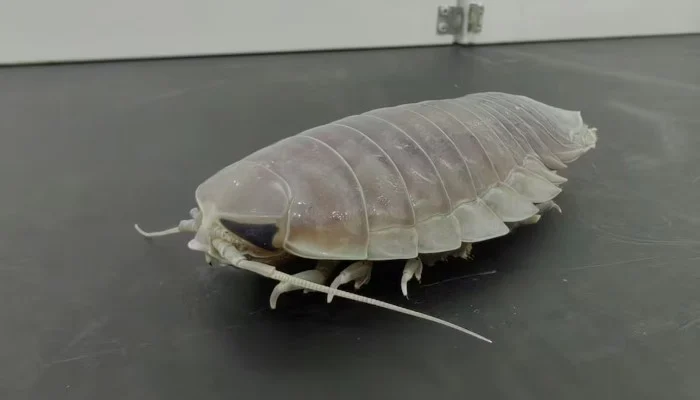
A pill bug hiding under a garden pot rolls itself into a small, armored sphere to defend against threats. Far beneath the ocean’s surface, some of its much larger relatives face a different challenge: how to survive when food might not arrive for years.
These animals are known as deep-sea isopods, a type of crustacean with flattened, segmented bodies. Recent research shows they’ve solved their survival dilemma using a combination of biological adaptations.
They inhabit a cold, pitch-dark environment resembling a barren desert, thousands of feet below the ocean surface, where food drops only sporadically in the form of “snowflakes” of organic debris from above, according to Jianhai Xiang, a crustacean biologist from the Institute of Oceanology, part of the Chinese Academy of Sciences, one of the study’s authors published in the journal Cell.
Xiang explains, “It’s a world of endless night and immense pressure, but life still finds a way.”
Thanks to their specialized biology, these creatures can endure more than five years without any food at all. Their survival strategy is a mix of physical and genetic features: a large stomach for storing food, a very slow metabolism, and a gene that regulates energy production.
They are scavengers living on the ocean floor, equipped with 14 jointed legs and a tough exoskeleton, thriving across the Atlantic, Pacific, and Indian oceans. Some grow over half a meter (20 inches) long. Similar to pill bugs, they can curl into a tight ball for protection.
Research primarily focused on two species: Bathynomus doederleini, found around 300 meters (985 feet) below the surface, and Bathynomus jamesi, which lives at about 900 meters (2,950 feet).
“Deep-sea isopods employ a clever “spend less, earn more” survival technique,” said Jianbo Yuan, lead author of the study. In the deeper species, the stomach takes up about two-thirds of its body cavity, allowing the isopod to store a significant meal when food becomes available.
Yuan describes it as a “food warehouse” that slowly releases energy while the animal remains in a sort of standby mode. With a drastically reduced metabolic rate, slower digestion, and highly efficient nutrient use, these isopods can stretch a single meal for years.
Their gut microbes may also play a part. In the species dwelling at greater depths, bacteria called Chlamydiae—known in humans and other animals for causing disease—are linked to fat storage, possibly providing the isopods with a steady energy source and offering the bacteria a reliable habitat.
Yuan adds, “This is a win-win situation.”
Energy regulation in these isopods may also involve ND1, a gene that appears to have originated from a symbiotic bacterium that once lived inside these animals before becoming part of their own genome. This process, known as horizontal gene transfer, involves DNA moving between unrelated organisms rather than being inherited from parent to offspring.
Yuan mentions, “The isopod seems to have ‘borrowed’ or ‘hijacked’ a bacterial gene to help control its energy use.”
Since studying live deep-sea isopods is challenging, the team tested ND1 in the lab on zebrafish, nematode worms, and human cells. The gene was shown to boost metabolism at normal temperatures but also helped conserve energy and prolong survival during starvation in cold conditions.
Yuan likens ND1 to a metabolic switch, adjusting energy expenditure based on the environment.
Professor Kahou Chu of the Chinese University of Hong Kong, a co-author of the study, notes that horizontal gene transfer can allow organisms to develop new traits more rapidly than traditional inheritance, giving some species an advantage in extreme environments.
Xiang emphasizes that the deep ocean, often called “Earth’s largest habitat,” is home to remarkable evolutionary adaptations that could inspire innovations in medicine, robotics, and conservation.
Understanding how these animals endure extreme food scarcity also provides insights into resilience amidst global changes like food-web disturbances and climate shifts.