
Select Language:
China is set to launch an astronaut to its space station on Sunday for a one-year mission, marking the longest stay in space for the country. This will facilitate research on long-term human health and physiology in space as Beijing advances toward its goal of a crewed moon landing by 2030.
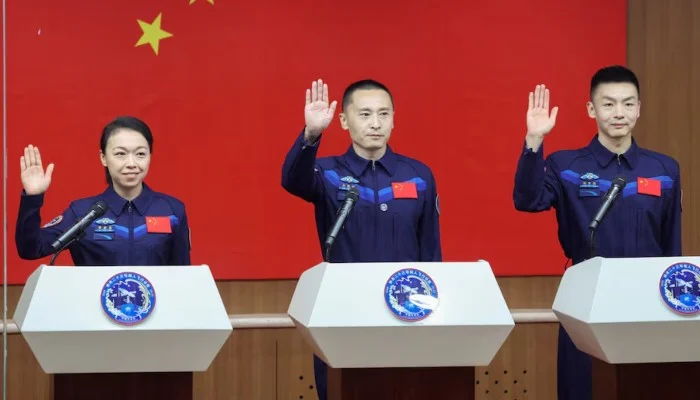
The launch of the Shenzhou-23 spacecraft is scheduled for 11:08 p.m. local time (3:08 p.m. GMT) from Jiuquan Satellite Launch Center in northwest China, with three Chinese astronauts onboard. Payload specialist Li Jiaying, a former Hong Kong police inspector, will be the first person from the city to participate in a Chinese space mission. The other crew members are Commander Zhu Yangzhu and Pilot Zhang Yuanzhi, both affiliated with the People’s Liberation Army’s astronaut division.
One of the crew members will remain on the Tiangong space station for a year, making it one of the longest space missions ever, though slightly shorter than the 14½ months record set by a Russian cosmonaut in 1995. The specific astronaut for this mission will be determined later, depending on the progress of the mission, according to the China Manned Space Agency.
This mission continues China’s nearly dozen previous manned missions to its space station, even as competition heats up with the U.S., which has raised concerns about China’s ambitions concerning lunar colonization and resource extraction — claims Beijing has strongly denied.
The U.S. aims for a crewed moon landing by 2028, two years ahead of China, and plans to establish a sustainable lunar presence as a stepping stone for future missions to Mars. Recently, NASA astronauts circled the moon in April as part of the Artemis II mission, flying farther than any humans have in over half a century. Meanwhile, SpaceX successfully conducted an uncrewed test flight of its next-generation Starship rocket, designed to frequent satellite launches and support lunar missions for NASA.
China faces a substantial challenge with less than four years to reach its 2030 lunar landing target, requiring the development of new hardware and software for lunar operations, ensuring astronauts can safely transition from the relative safety of the Tiangong station to the harsher lunar environment. While China has only deployed robotic missions to the moon so far, its Shenzhou series has demonstrated rapidly advancing space capabilities, including recovering lunar samples from the moon’s far side in June 2024, the first such achievement by any country.
A crewed lunar landing before 2030 would bolster China’s plans for a permanent lunar base in partnership with Russia by 2035. The Chinese lunar program’s chief scientist, Wu Weiren, has stated that Beijing’s official timeline is intentionally cautious. Over the past year, China has been testing hardware for the lunar mission, including heavy-lift Long March-10 rockets, the Mengzhou spacecraft, and the Lanyue lunar lander.
The upcoming Shenzhou-23 mission will feature the first autonomous, rapid rendezvous and docking with the core module of Tiangong, a critical step toward the 2030 lunar objectives, which include automated rendezvous between the Mengzhou capsule in lunar orbit and the Lanyue lander.
Additionally, scientists will investigate the physiological impacts of space travel, such as radiation exposure, bone density loss, and psychological stress during extended missions. Beijing is also pioneering experiments on human artificial embryonic development in space, having sent human stem cell samples to the Tiangong station this month, aimed at studying long-term survival and reproduction in space.
 ChatGPT
 Perplexity
 Gemini AI
 Grok AI