Select Language:
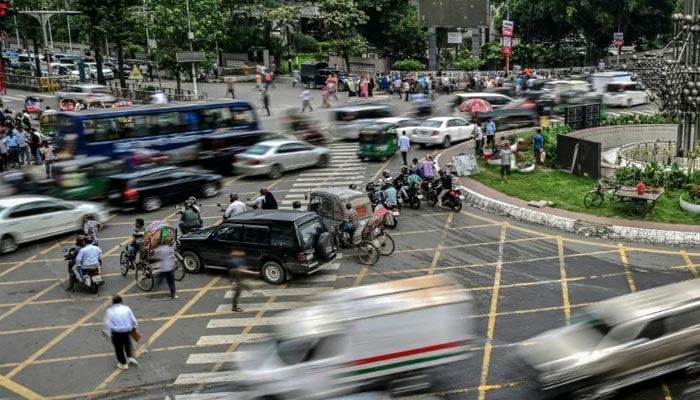
In April, Dhaka police integrated traffic cameras with artificial intelligence software to automatically detect violations. — AFP
Dhaka, Bangladesh’s densely populated capital notorious for severe traffic congestion, has introduced its first AI-based traffic enforcement system to help bring order to one of the world’s most jammed cities.
Vehicles—including buses, cars, motorcycles, and pedal rickshaws—frequently compete for space, often ignoring signals, pedestrian crossings, and traffic officers as mere obstacles.
Police often issue fines on the spot, which can lead to disputes, confrontations, and occasionally, officers being hit by vehicles that refuse to halt.
“Those who break the rules retaliate against us,” traffic sergeant SM Nazim Uddin told AFP.
“But since we started using AI, drivers are now more compliant, and we avoid daily arguments.”
Despite efforts to modernize traffic management, Dhaka, home to over 22 million residents, relied heavily on manual methods—such as officers stretching ropes across roads before lights turn green.
This changed in April when authorities linked traffic cameras with AI software capable of automatically identifying various infractions.
Dhaka police assert the technology can detect offenses ranging from red-light violations and improper lane usage to illegal parking. Motorist Hannan Rahman Jibon, 28, was among the first caught by the system.
“I ran a red light, and the owner of my car, who was at home, received a notification that I violated traffic laws,” said Jibon, who received an automatic fine of 2,000 Taka ($16).
“I’m now much more cautious, especially with cameras installed across different locations.”
According to a study by the U.S. National Bureau of Economic Research, Dhaka ranks as the “slowest city” worldwide. Its average travel speed is just 4.8 km/h (about 3 mph), making walking faster in many cases, based on research by the World Bank and Bangladesh University of Engineering and Technology.
City police spokesperson NM Nasiruddin explained that the AI system uses existing traffic camera feeds to identify violations, including signal and lane infractions, as well as illegal parking.
While coverage doesn’t encompass the entire city and manual enforcement will gradually be phased out, officials say the system is already changing driver behavior.
“We are starting to see results,” Nasiruddin stated. “We’ve prosecuted at least 300 vehicles so far.”
At the police command center, analyst Sharmin Afroze, 52, observes live traffic feeds integrated with the AI software, where flagged violations are reviewed by personnel.
“Before this system, police had to stop vehicles, check documents, and impose fines,” Afroze noted. “In just one day, the system logged nearly 800 violations.”
Currently, only the most serious offenders are fined, with others receiving warnings.
However, officials acknowledge challenges remain.
“For instance,” Afroze said, “some license plates are blurry or too small to identify.”
Authorities are working with transportation agencies to resolve these issues, and plans are underway to add features to monitor vehicles driving on footpaths.
The system primarily targets motor vehicles, but the city’s vast fleet of pedal rickshaws—which are central to Dhaka’s traffic—remains under consideration for regulation.
Professor Hasib Mohammed Ahsan from Bangladesh University of Engineering and Technology emphasized that the long-term success hinges less on technology and more on consistent enforcement.
“We’ve invested heavily in traffic signals and upgrades, yet these efforts haven’t been sustained,” Ahsan explained.
“Our problem is a lack of adherence to rules, inconsistent planning, and no accountability for failures.”
 ChatGPT
 Perplexity
 Gemini AI
 Grok AI