Select Language:
- Trump claims Washington has a strong trade agreement framework with China.
- China retaliates with tariffs, raising costs on both sides to over 100%.
- US tariffs on Chinese products to decrease to 30%, while China reduces its tariffs to 10%.
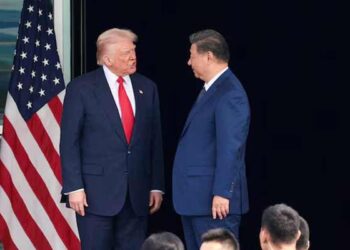
BEIJING: On Wednesday, the United States and China agreed to significantly reduce tariffs on one another’s products for a period of 90 days, following a temporary truce in their contentious trade war that has shaken global markets and disrupted international supply chains.
After crucial discussions in Geneva over the weekend, officials from both nations reached a consensus to cut down on exorbitant tariffs.
President Trump stated that the U.S. now has a blueprint for a “very, very strong” trade deal with China, which he believes will allow for greater access for American businesses into the Chinese market. This statement was made during an interview on Fox News that aired on Tuesday.
“We have laid the groundwork for a very robust agreement,” he said while traveling aboard Air Force One. “The most appealing aspect of this deal is opening China up to U.S. businesses.”
Trump’s administration previously imposed extensive tariffs that particularly impacted China, prompting retaliatory actions that drove tariffs on both sides to over 100%.
After significant losses in the stock market and pressure on businesses, negotiations began in Geneva aimed at breaking the deadlock.
The agreed terms include the U.S. reducing its tariffs on Chinese goods to 30%, while China will lower its tariffs to 10%, marking a decrease of more than 100 percentage points.
This reduction took effect shortly after midnight Washington time, signaling a major easing of trade tensions that had seen U.S. tariffs climb as high as 145% and even 245% for specific products.
As a result of the tariffs suspension, financial markets experienced a boost.
Chinese officials have been relatively reserved, presenting themselves at a recent summit in Beijing with Latin American leaders as stable advocates of globalization.
“There are no true winners in trade wars,” President Xi emphasized during the summit, while his foreign minister criticized a “major power” that operates under the belief that “might makes right.”
‘Risks of Renewed Tensions’
Despite the agreement, underlying issues persist — the U.S. retains a higher tariff rate than China due to a 20% charge linked to complaints over China’s exports of chemicals associated with fentanyl production.
Washington has long accused Beijing of ignoring the fentanyl crisis, a claim that China refutes.
While the U.S. sees potential for addressing the issue, China cautioned on Tuesday for the U.S. to “stop deflecting blame” towards it.
Experts warn that the potential for tariffs to resume after the 90-day period adds a layer of uncertainty. “Making further tariff reductions will be a challenge, and the risk of renewed conflict remains,” said Yue Su, a principal economist at The Economist Intelligence Unit.
Trump’s fluctuating tariff policies have significantly disrupted U.S. companies that rely on Chinese manufacturing, with the temporary reduction expected to offer only partial relief.
Moreover, Chinese officials have admitted that their economy, already struggling due to a lengthy property crisis and reduced consumer spending, is also impacted by the trade uncertainty.
“Both nations have experienced considerable economic hardship, and may still endure a bit more,” commented Dylan Loh, an assistant professor at Singapore’s Nanyang Technological University.
 ChatGPT
 Perplexity
 Gemini AI
 Grok AI