

Select Language:
The Challenge of Understanding Spanish Accents in 2025: A Fun Map Breakdown
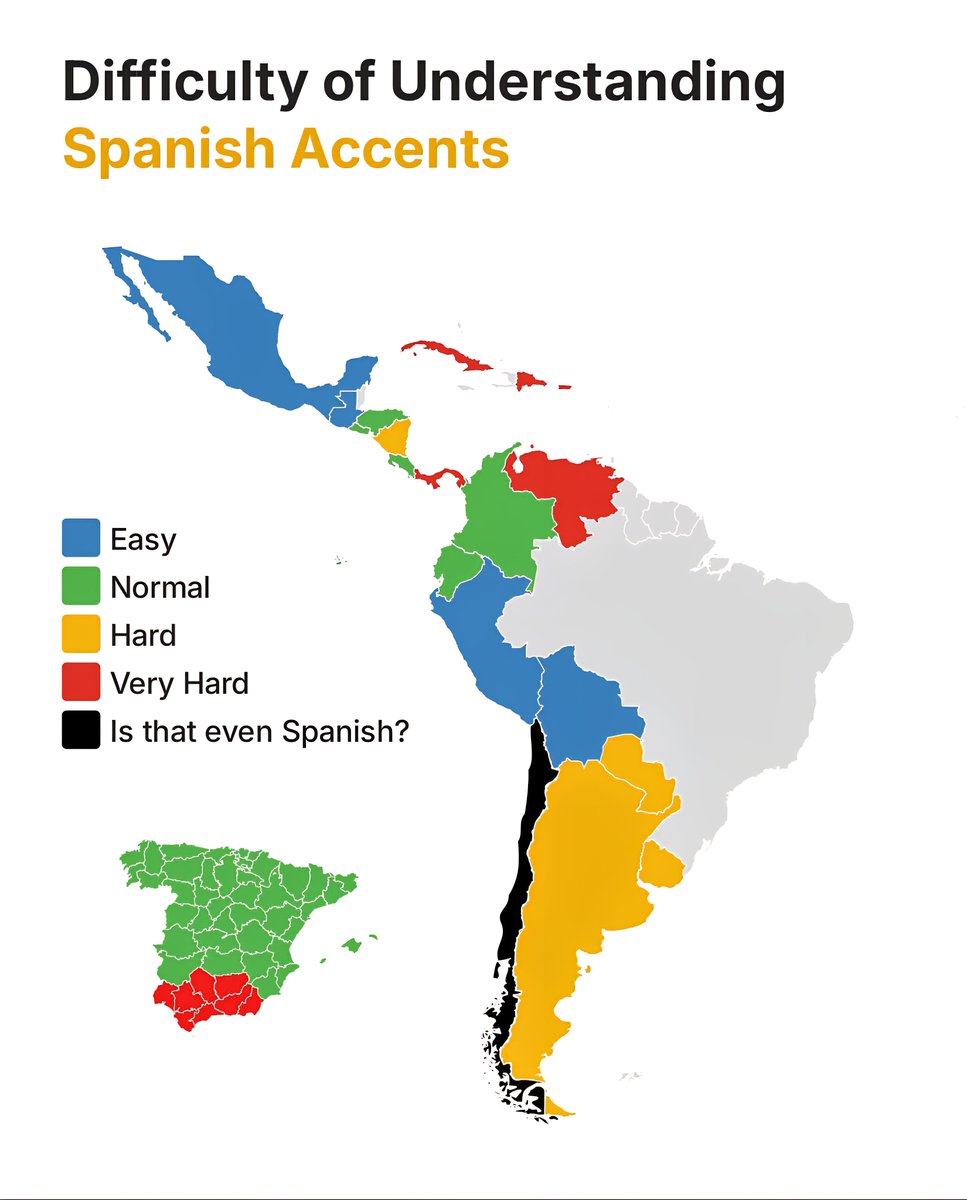
A new visual map has been circulating online, offering a colorful and engaging look at how difficult different Spanish accents are for speakers around the world to understand. Created to highlight the diversity within the Spanish language, this map categorizes accents into five levels of comprehension difficulty: Easy, Normal, Hard, Very Hard, and “Is that even Spanish?” Here’s a detailed breakdown of what this colorful map reveals about Spanish accents today.
Easy: Spanish Accents That Are Widely Understood
Accents marked in blue as “Easy” include those from regions where Spanish is the official language and the community’s speech patterns are most familiar to native speakers elsewhere. These include:
- Castilian Spanish (Spain): The standard variety spoken in Madrid, often considered the “neutral” accent, is generally easier for other Spanish speakers to understand due to its prominence and media exposure.
- Mexican Spanish: Given Mexico’s large population and extensive media influence, this accent is among the most recognizable and easiest for other Spanish speakers to understand.
- Colombian Spanish: Regions like Bogotá and Medellín are known for clear pronunciation, making their accents relatively accessible for other Spanish speakers.
Normal: Recognizable, Yet Slightly More Challenging Accents
Accents rated as “Normal” in yellow tend to be common but may have slight regional variations that could cause minor misunderstandings. These include:
- Argentine Spanish (Buenos Aires): The distinct “sh” sound in place of “ll” and some intonational patterns can trip up listeners not familiar with Argentine speech.
- Peruvian Spanish: Known for its clear enunciation, but some regional slang and intonations can быть initially challenging.
- Chilean Spanish: Characterized by rapid speech and unique pronunciation features, making it generally understandable but sometimes tricky.
Hard: Accents That Require More Effort to Comprehend
Accents marked in green as “Hard” include regions where Spanish pronunciation diverges significantly from standard forms, often due to indigenous influences or historical language evolution:
- Caribbean Spanish (Cuba, Puerto Rico, Dominican Republic): The rapid tempo and dropping of final consonants make these accents more demanding for non-native speakers.
- Andalusian Spanish (Southern Spain): Features like dropping the “s” sound and unique intonations can confuse listeners unfamiliar with the region’s speech pattern.
- Venezuelan Spanish: While generally understandable, certain regional pronunciations can make comprehension occasionally challenging.
Very Hard: Accents That Pose Significant Listening Challenges
Accents classified as “Very Hard” in red include those that might require advanced familiarity with regional speech patterns:
- Mexican Coastal & Tapachula Dialects: Unique pronunciation features and fast speech make these accents some of the most difficult for outsiders.
- Certain rural accents in Central America: Variations in pronunciation, rapid speech, and local slang make comprehension more difficult for many listeners.
- Bolivian Spanish (Altiplano regions): The influence of indigenous languages and slower, more accented speech complicates understanding for non-locals.
Is That Even Spanish? The Outliers and Puzzling Cases
The black box, marked “Is that even Spanish?”, includes accents and dialects that are so heavily influenced by indigenous languages or immigrant languages that they may not be immediately recognizable as Spanish:
- Unique Caribbean Creoles or Afro-Spanish dialects: These blends may contain significant vocabulary and syntax deviations.
- Some indigenous language-influenced dialects: Variations in pronunciation and grammar can make these dialects nearly unintelligible to those unfamiliar with their origins.
Understanding the diversity of Spanish accents is crucial, particularly given the language’s vast global presence. This map humorously underscores how rich and varied the language truly is, and how the barriers to understanding can vary widely depending on regional influences and linguistic evolution.
As the world continues to foster cross-cultural communication, becoming familiar with these accent differences can enhance comprehension and foster deeper appreciation for the language’s rich tapestry. Whether you’re a traveler, language learner, or native speaker, recognizing the complexity behind each regional accent can transform how you experience Spanish in 2025.
This lively map invites both curiosity and challenge—reminding us that language is as colorful and complex as the cultures it represents.
 ChatGPT
 Perplexity
 Gemini AI
 Grok AI