

Select Language:
Exploring the Global Use of Stars on National Flags in 2025
1. The Symbolic Power of Stars in Flag Design
Stars have long been a symbol representing unity, aspiration, guidance, and sovereignty in national flags worldwide. Their presence often signifies ideals like hope, progress, or specific historical and cultural elements unique to each country. As we progress into 2025, a closer look at the countries featuring stars on their flags reveals some interesting patterns and historical insights.
2. Countries with Flags Featuring a Single Star
Some nations opt for a prominent, singular star that often symbolizes a unifying ideal or specific national identity. For example:
-
China: The five-star design on the Chinese flag symbolizes the unity of the Chinese people under the leadership of the Communist Party. The largest star represents the Communist Party, while the four smaller stars symbolize the four classes of people as defined by Maoist thought.
-
Vietnam: The vibrant red flag sported with a large yellow star signifies socialism and unity. The five points of the star represent workers, peasants, soldiers, intellectuals, and youth—key groups in Vietnam’s society.
-
Somalia: Simple yet powerful, the white star on a blue field expresses Somali independence and unity, with the five points representing the five regions of Somali inhabited areas.
3. Flags with Multiple Stars and Their Symbolisms
Many nations incorporate multiple stars into their flags, with each star carrying specific staying power or regional significance:
-
United States: The iconic flag with 50 stars reflects the 50 states of the union, signifying unity and sovereignty in the American fabric.
ADVERTISEMENT -
European Union Members: Multiple flags across Europe feature stars, often representing unity and cooperation among member countries. For instance, the European Union flag features 12 stars arranged in a circle, symbolizing unity, harmony, and completeness, despite the number of member states changing over time.
-
China (again) displays one large star alongside four smaller stars, symbolizing the importance of regional groups and the motherland.
4. Countries Without Stars on Their Flags
The absence of stars doesn’t diminish a country’s identity but often reflects different historical or cultural pathways. Many nations favor other symbols such as crosses, crescent moons, or abstract designs.
-
United Kingdom: Its Union Jack features a complex design of crosses representing the union of England, Scotland, and Ireland, with no stars in the design.
-
Switzerland: The classic white cross on a red square signifies neutrality and calm strength, with no stars incorporated.
-
Japan: The simple red circle represents the sun, symbolizing energy and vitality, with no stars included.
5. Emerging Trends in Flag Design: Minimalism and Symbolism
In recent years, flag design has trended toward minimalist aesthetics, making stars less common or more stylized. Countries are aiming for simple, recognizable symbols that embody national values without overcrowding the design. The clean silhouette of a single star or a minimal number of stars aligns with this trend.
6. The Role of Cultural and Political Changes in Flag Designs
Flags evolve alongside political shifts and cultural developments. For instance, nations undergoing independence or political reform often add or modify stars on their flags to represent new ideals or sovereignty:
-
Countries like South Sudan, which gained independence in 2011, adopted flags with prominent stars to symbolize hope and a bright future.
-
Some countries have retired stars to reflect political shifts or to distance themselves from previous regimes.
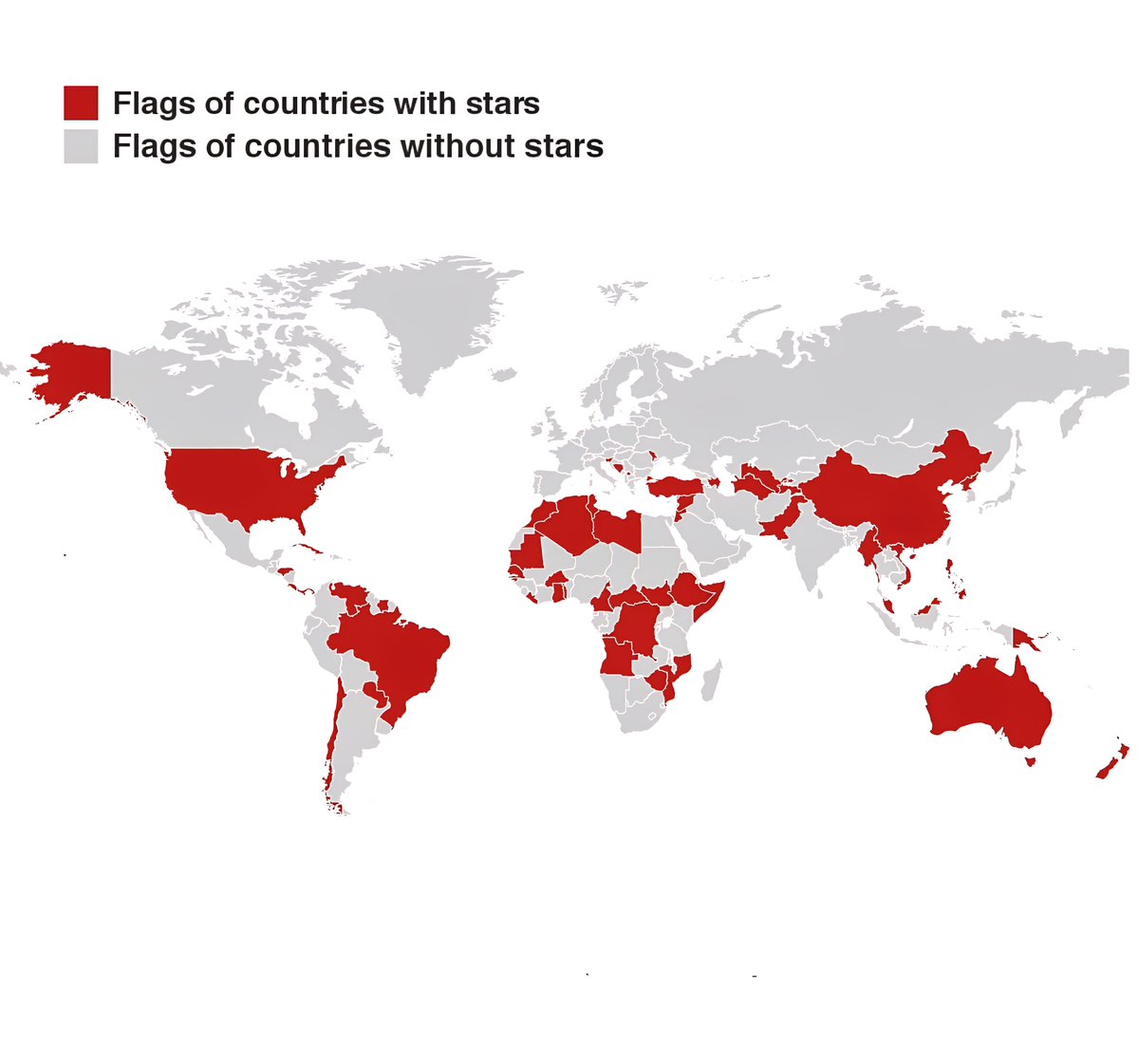
7. Global Distribution and Trends in 2025
The map of flags featuring stars reveals interesting geographical patterns:
-
Asia and Africa continue to use stars prominently, reflecting ideological influences and tradition.
-
Western countries tend to favor other symbols but occasionally incorporate stars for aesthetic reasons or regional affiliations.
-
Small island nations often use stars due to their simplicity and symbolic neutrality.
8. Final Takeaways
Stars on flags continue to serve as potent symbols of aspiration, unity, and cultural identity in 2025. Their presence or absence often tells a story about a nation’s history, values, and political path. As design trends move toward simplicity and meaning-driven symbols, stars are likely to maintain their significance, either as prominent elements or subtle nods to tradition.
In summary, whether illuminating the sky or representing axes of unity, stars remain a defining feature of national identities around the world.
 ChatGPT
 Perplexity
 Gemini AI
 Grok AI