

Select Language:
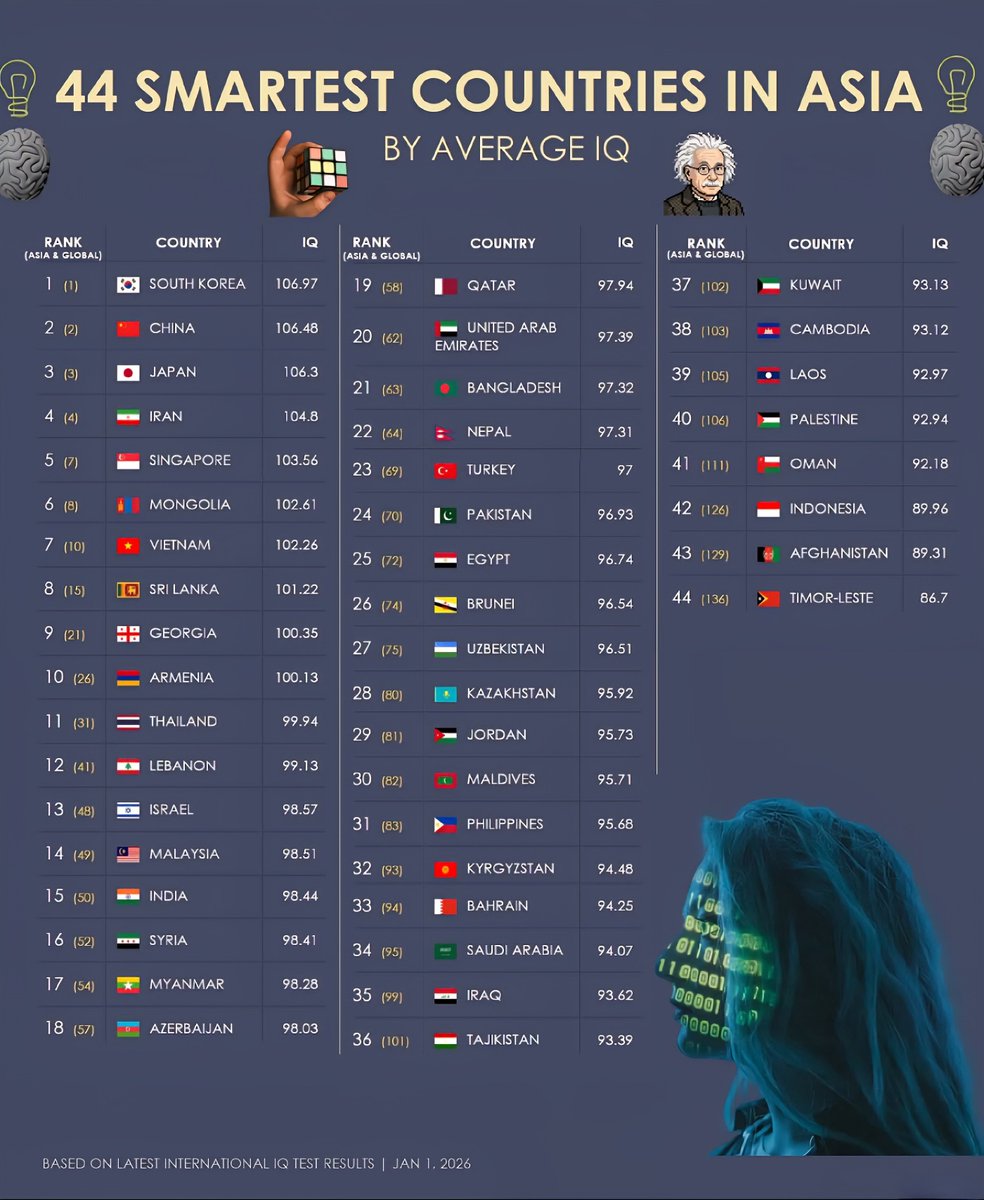
Top 44 Countries in Asia for Highest Average IQ in 2025
South Korea Ranks Highest in Intelligence Metrics
South Korea continues to lead Asia with an impressive average IQ of 106.97, maintaining its position as the smartest nation on the continent. With a population dedicated to technological innovation and rigorous education systems, South Korea has consistently scored high in global intelligence rankings over recent years.
China and Japan Keep Their Stronghold
Following closely behind, China holds an average IQ of 106.48, reflecting its rapid economic development and emphasis on STEM education. Japan is not far behind at 106.30, showcasing its ongoing commitment to education excellence and innovation. These countries set the standard for intellectual achievement across the region.
Iran and Singapore: Rising Intelligence Leaders
Iran ranks fifth with an average IQ of 104.80, driven by expanding educational opportunities and scientific research. Singapore continues to shine with an average IQ of 103.56, thanks to its highly competitive education system and focus on technological advancement. Both nations are setting benchmarks for intellectual growth in Asia.
Mongolia and Vietnam Show Notable Progress
Mongolia’s average IQ stands at 102.61, marking significant progress due to increased access to quality education and modernization. Vietnam follows with an average of 102.26, demonstrating the country’s focus on education reform and youth development initiatives.
South Asian Countries: Emerging Competitors
Sri Lanka scores 101.22, reflecting improved literacy rates and educational infrastructure. India, with an average IQ of 98.44, remains a major player in the region, driven by a large, diverse population and expanding higher education sectors. Pakistan and Bangladesh trail closely, with averages of 96.93 and 97.32 respectively, highlighting ongoing efforts to boost educational standards despite economic challenges.
Middle Eastern Nations Leading IQ Growth
Israel holds a notable average IQ of 98.57, credited to its emphasis on research and technological innovation. Qatar and the United Arab Emirates also make the list, with averages of 97.94 and 97.39, respectively, showcasing their investments in education and science infrastructure.
Southeast Asia’s Educational Aspirations
Thailand, Malaysia, and the Philippines demonstrate steady scores of approximately 99 to 95.68, indicating focus on expanding access to quality education and fostering intellectual development among younger populations.
Central Asian and Caucasus Countries
Georgia and Armenia rank at around 100 and 100.13, displaying steady educational progress. Kazakhstan (95.92) and Uzbekistan (96.51) are also making strides in improving educational systems to foster higher IQ scores across their populations.
Countries Facing Challenges
Afghanistan and Timor-Leste sit at the lower end of the spectrum, with averages of 89.31 and 86.70, respectively. These numbers reflect ongoing struggles with access to quality education, political instability, and economic hurdles.
Summary of Asian IQ Averages
This comprehensive data, gathered from over 1.2 million test-takers worldwide, emphasizes the stark contrasts and developmental stages across Asian nations regarding intellectual performance. Countries investing heavily in education, technology, and scientific research tend to perform better on the IQ scales, reinforcing the importance of sustained educational improvements.
| Country | Average IQ |
|---|---|
| South Korea | 106.97 |
| China | 106.48 |
| Japan | 106.30 |
| Iran | 104.80 |
| Singapore | 103.56 |
| Mongolia | 102.61 |
| Vietnam | 102.26 |
| Sri Lanka | 101.22 |
| Georgia | 100.35 |
| Armenia | 100.13 |
(Additional rankings continue down the list)
Final Thoughts
By 2025, the intelligence landscape across Asia demonstrates a clear correlation between investments in education and measurable cognitive achievement. While some countries have made remarkable progress, others still face significant challenges. Continued focus on quality education, technological innovation, and policy support will be crucial for lifting IQ scores and fostering overall development in the years ahead.
Source: International IQ Test 2025
 ChatGPT
 Perplexity
 Gemini AI
 Grok AI