

Select Language:
China Continues Its Economic Dominance
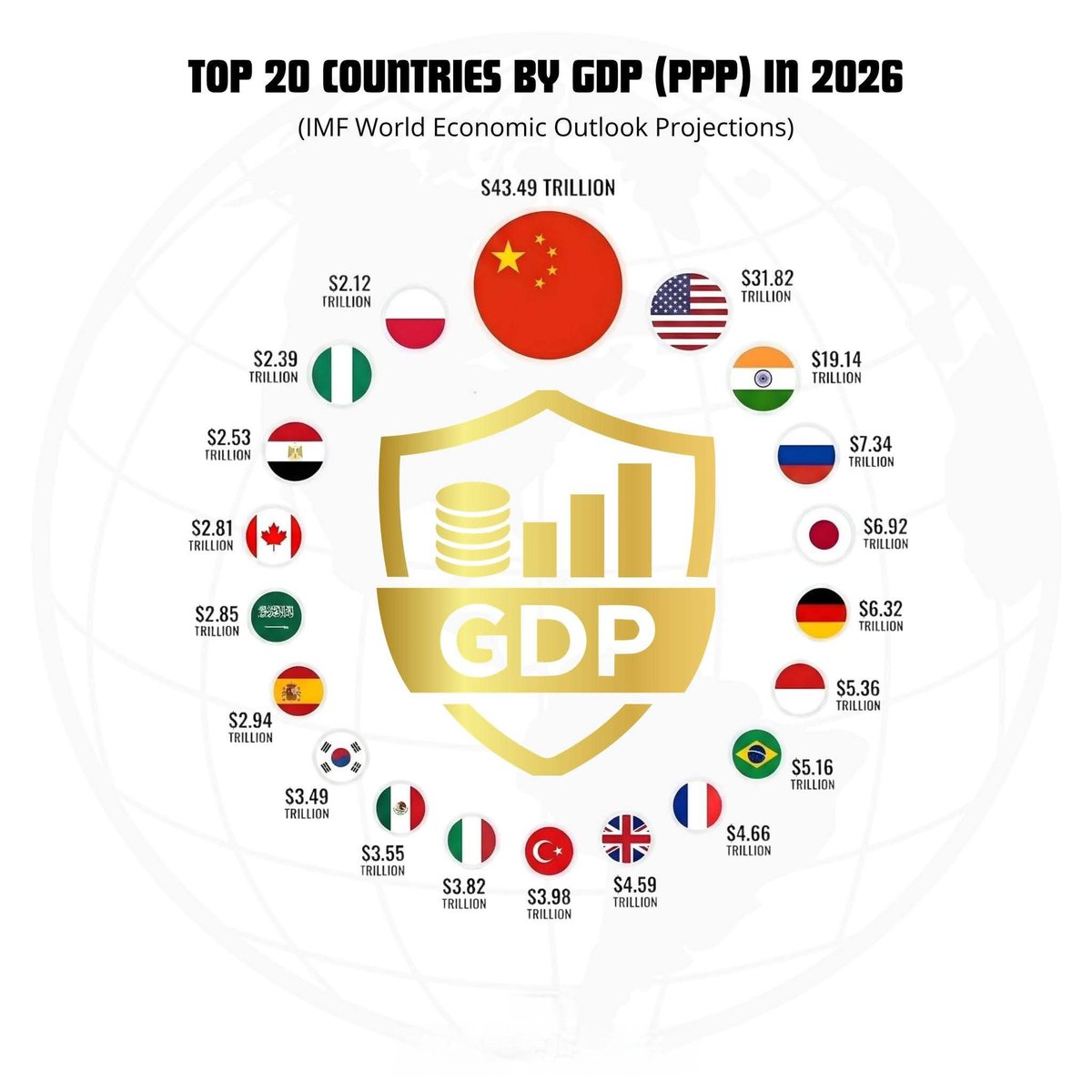
In 2026, China maintains its position as the world’s largest economy based on Purchasing Power Parity (PPP), boasting a staggering GDP of $43.49 trillion. This continued growth emphasizes China’s expanding influence on global markets, technological innovation, and investment in infrastructure. The country’s focus on domestic consumption and export-driven sectors keeps it at the forefront of the global economic landscape. China’s leadership in manufacturing and technology sectors attracts investment from around the world, solidifying its economic position further.
The United States Retains Its Place as a Global Powerhouse
Holding the second spot, the United States’ economy is valued at $31.82 trillion. Despite recent challenges, the U.S. remains a dominant economic player driven by innovation, a robust service sector, and significant investments in emerging technologies such as artificial intelligence and renewable energy. Leadership in these areas helps the U.S. stay competitive, influencing global economic trends and policies.
India’s Rapid Economic Growth
India climbs to the third position with a GDP of $19.14 trillion, reflecting rapid economic expansion and increased foreign investment. The country’s youthful population, technological advancements, and reforms in infrastructure are critical drivers behind this growth. India is positioning itself as a key player in the global digital economy, with a booming tech sector and a burgeoning middle class fueling sustained economic momentum.
Russia’s Stable Yet Challenged Economy
Russia’s economy stands at $7.34 trillion, maintaining a significant presence mainly due to its vast natural resources, particularly in energy exports. However, geopolitical tensions, sanctions, and transitioning toward diversifying its economy remain challenges that could impact Russia’s future growth trajectory.
Japan’s Consistent Economic Presence
Japan, with a GDP of $6.92 trillion, stays among the top economies. Its advanced technology, automotive industry, and innovation sectors continue to drive its economy. Despite demographic challenges like an aging population, Japan’s focus on robotics and electronic goods keeps its economy resilient.
Germany’s Steady Economic Power
Germany retains its industrial strength with a GDP of $6.32 trillion. As Europe’s largest economy, it benefits from a highly skilled workforce, a strong manufacturing sector, and leadership in green technologies. Germany’s role as a key trade partner within the European Union sustains its economic resilience.
Indonesia’s Emerging Market Status
With a GDP of $5.36 trillion, Indonesia emerges as Southeast Asia’s economic powerhouse. Its rich natural resources, young population, and expanding manufacturing base contribute to rapid economic growth. The country is becoming a significant player in regional trade and investment.
Brazil’s Representation from South America
Brazil, with a GDP of $5.16 trillion, remains South America’s largest economy. Agricultural exports, mining, and renewable energy investments are major contributors. Brazil’s efforts to diversify its economy and improve infrastructure are crucial for sustained growth.
France and the United Kingdom in the European Mix
France ($4.66 trillion) and the United Kingdom ($4.59 trillion) maintain their positions as significant EU economies. France’s diversified economy, including luxury goods, aerospace, and tourism, complements the UK’s financial services, technology, and creative industries. Both countries are pivotal in shaping European and global economic policies.
Turkey’s Strategic Growth
Turkey lands within the top 12 with a GDP of $3.98 trillion. Its strategic geographical position, expanding industrial base, and youthful workforce drive economic expansion. Turkey’s focus on infrastructure projects and manufacturing continues to attract foreign investment.
Italy’s Steady Presence
Italy’s economy, valued at $3.82 trillion, remains crucial in Europe, especially in luxury goods, fashion, and automotive sectors. Italy’s focus on innovation and tourism helps sustain its economic position despite challenges.
Mexico’s Growing Influence
With a GDP of $3.55 trillion, Mexico strengthens its economic ties with North America. Its manufacturing exports, particularly in automobiles and electronics, along with a rising middle class, support ongoing growth.
South Korea’s Technological Leadership
South Korea’s economy is valued at $3.49 trillion, driven by advanced electronics, automobiles, and telecommunications industries. Its focus on innovation and technological integration sustains its competitive edge.
Spain’s Recovery and Growth
Spain’s economy ($2.94 trillion) continues to recover post-pandemic, bolstered by tourism, manufacturing, and renewable energy investments. Its strategic location in Europe positions it as a key trade hub.
Saudi Arabia’s Diversification Efforts
Saudi Arabia’s GDP ($2.85 trillion) reflects its efforts to diversify beyond oil, investing heavily in entertainment, tourism, and renewable energy projects, aiming to reduce dependence on hydrocarbons.
Canada’s Stable Economy
Canada, with $2.81 trillion, benefits from abundant natural resources, including energy and minerals, alongside a strong services sector. Its diverse economy and stable policies make it a resilient player.
Egypt’s Rising Economy
Egypt’s economy ($2.53 trillion) stands out in Africa for its strategic location and investments in infrastructure, energy, and tourism. Economic reforms are attracting foreign investment amid internal growth.
Nigeria’s Potential
Nigeria, valued at $2.39 trillion, is Africa’s largest economy by PPP. Its rich natural resources and expanding tech and entertainment sectors present promising growth prospects, despite infrastructural challenges.
Poland’s Growing Role in Europe
Poland, with a GDP of $2.12 trillion, benefits from integration within the European Union, increasing manufacturing, IT, and service exports. Ongoing development projects aim to enhance its economic stature.
Source: IMF World Economic Outlook Projections 2025
 ChatGPT
 Perplexity
 Gemini AI
 Grok AI