
Select Language:
Top 10 Largest Subdivisions on the Planet in 2025
1. Sakha Republic, Russia – Covering Over 3 Million Square Kilometers
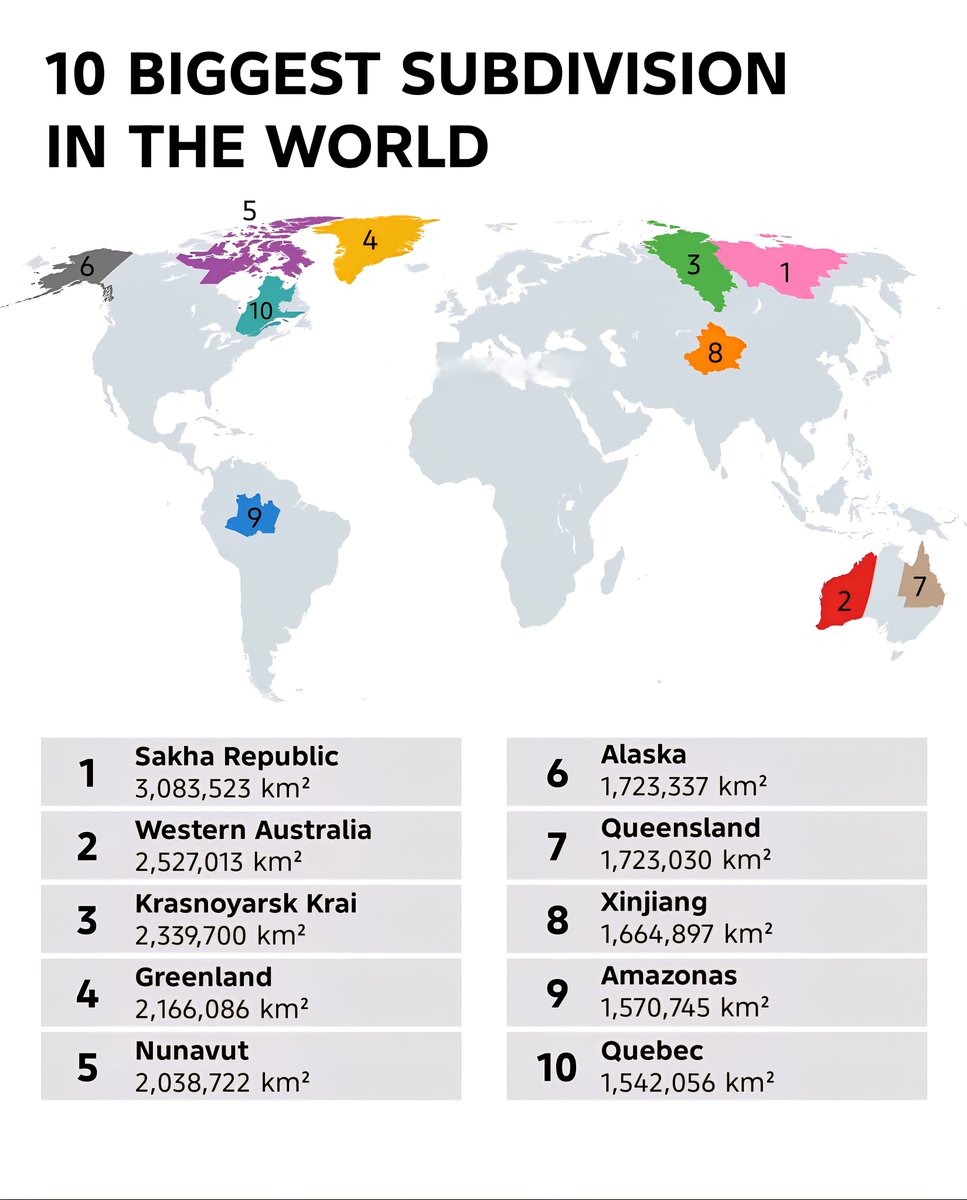
The Sakha Republic, also known as Yakutia, stretches across approximately 3,083,523 square kilometers, making it the largest subdivision globally. Located in Russia’s far eastern part, this region is famed for its extreme cold, vast wilderness, and rich mineral resources. Despite its size, it’s sparsely populated, with most residents living in small settlements scattered across the icy landscape. The Sakha Republic plays a vital role in Russia’s resource extraction industries, especially in diamond mining, contributing significantly to the country’s economy.
2. Western Australia, Australia – Spanning Over 2.5 Million Square Kilometers
Western Australia is the largest state in Australia, encompassing 2,527,013 square kilometers. This expansive region is characterized by its diverse landscapes — from arid deserts and rugged coastlines to lush forests. As the resource hub of Australia, Western Australia is pivotal in mining sectors, producing minerals like iron ore, gold, and nickel. Its remote communities are often linked through extensive infrastructure networks, supporting both local economies and international exports.
3. Krasnoyarsk Krai, Russia – Over 2.3 Million Square Kilometers
Krasnoyarsk Krai ranks third with roughly 2,339,700 square kilometers of territory. Located in central Siberia, this vast subdivision is known for its diverse geography, which includes mountains, taiga forests, and river systems. Krasnoyarsk serves as a critical hub for Russia’s hydroelectric power generation, with the Yenisei River notably powering numerous hydroelectric stations. Its extensive forests also make it a key player in Russia’s timber industry.
4. Greenland, Denmark – Covering About 2.17 Million Square Kilometers
Despite being the world’s largest island, Greenland functions as an autonomous territory within Denmark, stretching across approximately 2,166,086 square kilometers. Its icy landscapes and abundant natural resources—including minerals and potential offshore oil—are of increasing interest globally. Greenland’s glaciers and tundra host unique ecosystems and are essential for climate change studies. As it searches for sustainable development options, the region is also focusing on indigenous rights and environmental preservation.
5. Nunavut, Canada – Nearly 2 Million Square Kilometers
This Canadian territory spans about 2,038,722 square kilometers, making it the fifth-largest subdivision. Nunavut is renowned for its indigenous Inuit culture, expansive wilderness, and arctic environment. It plays a prominent role in Canada’s resource extraction, with hunting, fishing, and mining forming the backbone of its economy. The territory is also vital for Arctic research and climate monitoring, given its sensitive ecosystems and rapidly changing climate conditions.
6. Alaska, United States – About 1.72 Million Square Kilometers
Alaska, the largest U.S. state, covers approximately 1,723,337 square kilometers. Its landscape includes majestic mountains like Denali, endless forests, and Arctic tundra. Alaska is rich in natural resources, including oil, natural gas, and seafood, which heavily influence its economy. Strategic military importance, indigenous communities, and ecotourism also define Alaska’s prominence on the global stage.
7. Queensland, Australia – Slightly Smaller Than Alaska at 1.72 Million Square Kilometers
Queensland is Australia’s second-largest state, boasting 1,723,030 square kilometers of land. Known for its tropical climate, Great Barrier Reef, and diverse wildlife, Queensland is a major tourist destination. Its economy also depends heavily on agriculture, mining, and energy production, making it a vital part of Australia’s overall economic landscape.
8. Xinjiang, China – Covering 1,664,897 Square Kilometers
Xinjiang Uyghur Autonomous Region is a sprawling area in China’s northwest, with a size of roughly 1,664,897 square kilometers. It is rich in natural resources, including oil, natural gas, and minerals. Xinjiang’s diverse cultural tapestry features Uyghur traditions alongside Han Chinese influences. The region is critical for China’s Belt and Road Initiative, serving as a strategic economic and logistical hub.
9. Amazonas, Brazil – Encompassing 1,570,745 Square Kilometers
The Amazonas state, sharing its name with the mighty Amazon rainforest, covers an estimated 1,570,745 square kilometers. It is home to what is arguably the world’s most biodiverse rainforest, vital for global climate regulation and indigenous communities. The region is influential in Brazil’s ecological and economic landscapes, with forestry, fishing, and ecotourism being primary industries.
10. Quebec, Canada – Nearly 1.54 Million Square Kilometers
Quebec is Canada’s largest province, spanning 1,542,056 square kilometers. Known for its predominantly French-speaking population, Quebec boasts vast forests, lakes, and hydroelectric power capabilities. It is an economic hub for natural resources, renewable energy, and cultural industries, heavily influencing Canada’s national identity.
These vast regions and territories show the incredible geographical diversity and economic significance of the world’s largest subdivisions today. With ongoing developments in resource management, indigenous rights, and environmental conservation, these areas remain central to global discussions about sustainability and growth in 2025.
 ChatGPT
 Perplexity
 Gemini AI
 Grok AI