

Select Language:
Unveiling the True Size of Australia: What You Need to Know in 2025
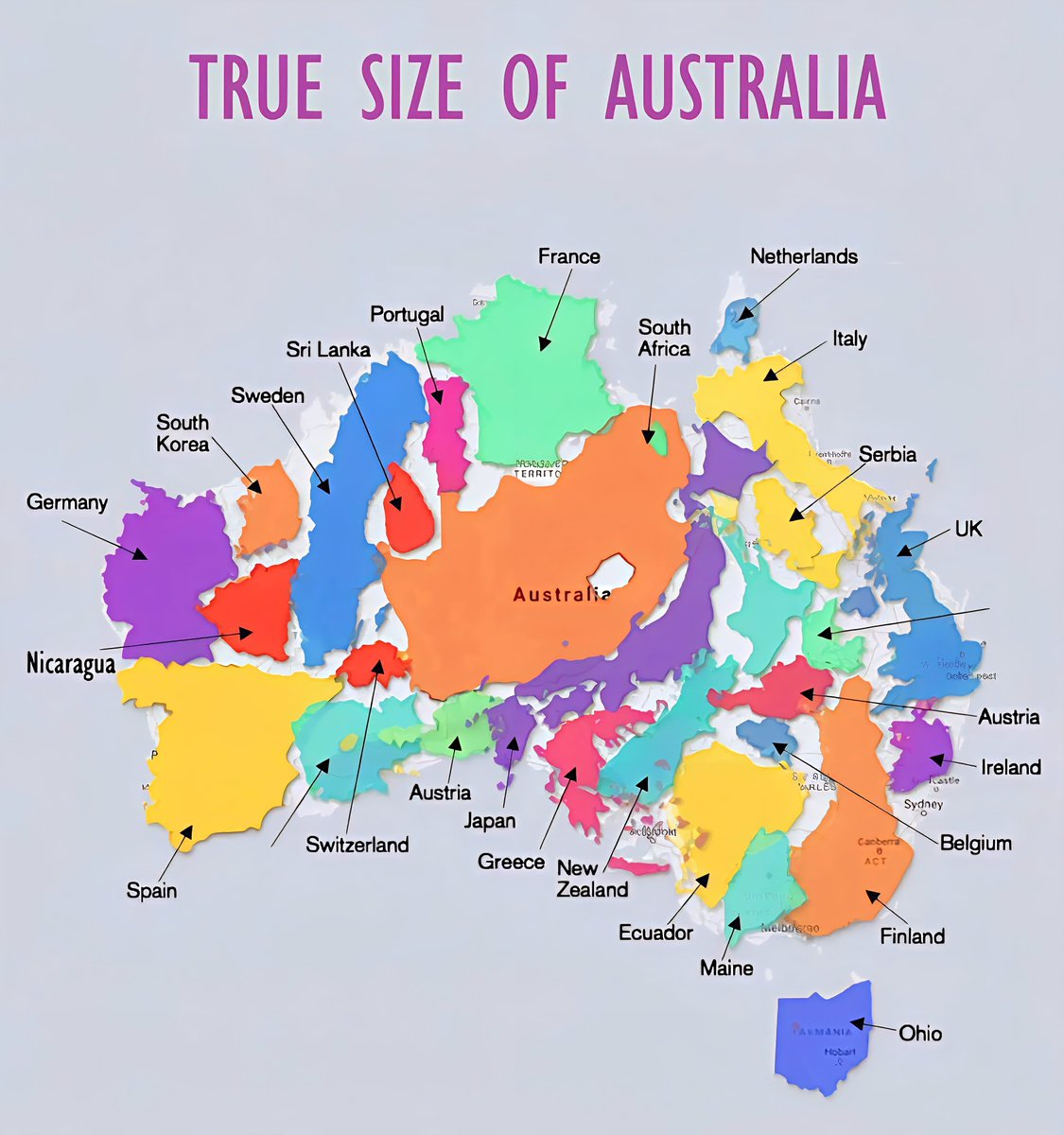
Australia, the land Down Under, often surprises many with its immense size. But just how large is it compared to other countries and regions? In 2025, new data and innovative visualization tools have helped paint a clearer picture of Australia’s true size, reshaping perceptions around the world. Here’s a detailed look at what makes Australia massive and why understanding its true dimensions matters.
Australia vs. the Rest of the World: How Big Is It Really?
Many people underestimate Australia’s size mainly because of its distinct shape and the way maps are projected. When you look at a standard Mercator projection, Australia appears smaller than its actual size. However, in reality, Australia’s landmass is roughly 2.97 million square miles (7.69 million square kilometers), making it the sixth-largest country globally.
Compared to the United States, which has about 3.8 million square miles, Australia is slightly smaller, but its dimensions are more vertically expansive, stretching across the continent from north to south. This size means Australia is comparable to the entire continental United States, but it maintains a more isolated and distinct geographical identity.
The Impact of Map Projections on Perception
Map projections can distort the size of countries, leading to misconceptions. The most common example is the Mercator map, which enlarges regions near the poles and diminishes those near the equator. As a result, countries like Greenland and Africa appear more massive than they are compared to countries like Australia.
To address false perceptions, cartographers in 2025 are increasingly using equal-area projections like the Gall-Peters map, which accurately represent relative sizes. As a result, Australia’s true size is better visualized, showing it as a landmass larger than most people realize.
Australia’s Size Compared to Other Continents
- Australia vs. Africa: Africa covers approximately 11.7 million square miles, making it nearly four times larger than Australia. However, Australia’s outback and vast desert areas make it seem more expansive than many expect.
- Australia vs. South America: South America spans over 6.8 million square miles, making it more than twice Australia’s size. Yet, in terms of landmass, Australia ranks as the sixth-largest country.
- Australia vs. Europe: Europe is approximately 3.9 million square miles, so Australia surpasses it comfortably, emphasizing its massive scale.
Unique Challenges of a Large Landmass
Having an extensive land area brings specific challenges and advantages:
- Biodiversity: Australia is home to unique ecosystems and species found nowhere else, such as the kangaroo and wombat. Its size supports diverse climates from tropical rainforests to arid deserts.
- Infrastructure and Development: Large size means that infrastructure development must be thoughtfully planned. Many cities, like Sydney and Melbourne, are geographically isolated from the wilderness and each other, impacting transportation and communications.
- Environmental Conservation: Protecting such a vast landscape requires significant effort, especially with threats like climate change, wildfires, and invasive species becoming more prevalent.
The Role of Technology in Visualizing Australia’s Size
By 2025, cutting-edge technology has allowed for interactive tools that demonstrate Australia’s actual size in comparison to other countries. These tools enable users to see how Australia fits within the context of the world map, dispelling myths created by traditional maps and confusing projections.
These visual aids are not only educational but also pivotal for policymakers, environmentalists, and educators aiming to accurately communicate Australia’s importance and scale on the world stage.
Why Knowing the True Size of Australia Matters
Understanding Australia’s real dimensions is more than just geography trivia; it influences:
- Global Politics: Recognizing Australia’s vast territory is essential for understanding its geopolitical influence and territorial disputes.
- Economic Strategies: Its size supports diverse industries like mining, agriculture, and tourism—each requiring different logistical considerations.
- Environmental Policy: Accurate knowledge helps in planning conservation efforts and responding to climate challenges effectively.
In Summary
Australia’s true size exceeds many perceptions, and in 2025, new tools and data highlight its significant landmass. Recognizing its real dimensions helps foster better understanding of the country’s ecological, infrastructural, and geopolitical importance in the world.
Note: The image attached provides a visual comparison of Australia’s size, illustrating its vastness and the importance of viewing it beyond traditional map distortions.
 ChatGPT
 Perplexity
 Gemini AI
 Grok AI