
Select Language:
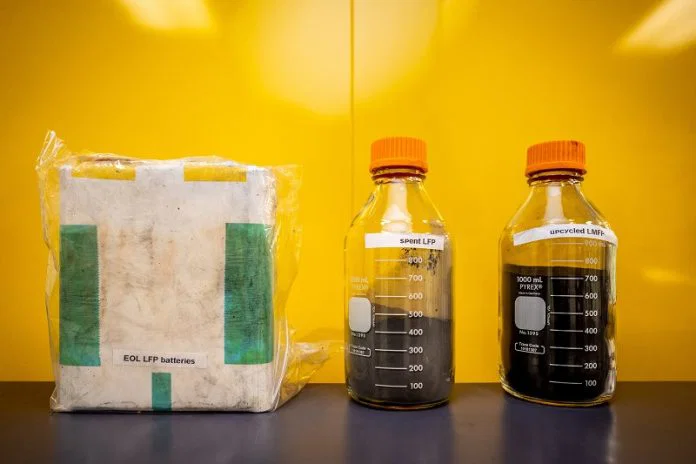
UC San Diego engineers have devised a new technique to repurpose spent lithium iron phosphate (LFP) batteries, transforming them into higher-performing battery materials. This process begins with disassembling an end-of-life LFP battery pack, isolating the cathode material as a powder, and then converting it into lithium manganese iron phosphate (LMFP), a more energy-dense cathode material. This innovative approach not only promotes recycling but enhances battery capacity and longevity.
LFP batteries are prevalent in electric vehicles and large energy storage systems because they are safe, durable, and cost-effective compared to other lithium-ion types. They also sidestep the use of expensive metals like cobalt and nickel, making up nearly half of the global lithium-ion battery market.
With the increasing number of EV batteries reaching the end of their lifespan, developing cleaner, more efficient recycling methods is crucial. Traditional recycling techniques often involve high-temperature processes or aggressive chemicals that consume significant energy and produce pollution and waste.
In contrast, the new method upgrades existing battery material instead of breaking it down entirely. After harvesting the cathode material, it is cleaned and broken into smaller pieces before being soaked in water. Gentle stirring helps separate the active components from supporting aluminum foil, which can then be recycled separately. The remaining material is dried, ground into a fine powder, and then combined with lithium, manganese, and phosphate compounds—materials necessary for creating the upgraded cathode.
Since direct mixing of these ingredients isn’t effective due to differing crystal structures, the team developed an intermediate compound called lithium manganese phosphate (LMP). LMP closely resembles the original LFP crystal structure, allowing for better integration. The mixture is finely ground and heated in a furnace; during this process, manganese atoms gradually replace some iron atoms, forming a uniform LMFP material. A carbon coating forms around each particle, improving electrical conductance and protecting the material during charge cycles.
Testing showed that the upgraded LMFP material can store more energy while maintaining safety and durability. The process proved effective across different battery brands, demonstrating its broad applicability. Moreover, scaling up from laboratory-sized samples to larger, commercially relevant quantities was successful, with the new material performing well in both small test cells and larger battery modules similar to those used in electric vehicles.
Looking ahead, researchers aim to refine the process for higher efficiency and further enhance battery performance. If these improvements are achieved, this innovative recycling method could significantly reduce waste, cut manufacturing costs, and contribute to the development of more powerful, environmentally friendly batteries.
 ChatGPT
 Perplexity
 Gemini AI
 Grok AI