
Select Language:
Imagine dozens of small robotic boats drifting along a river, coming together to form a bridge, a stage, or a temporary platform anytime it’s needed. Once the task is complete, the robots split apart and move on to create something entirely different. This futuristic concept is now becoming a reality through a project called FloatForm, developed by researchers at the Massachusetts Institute of Technology (MIT).
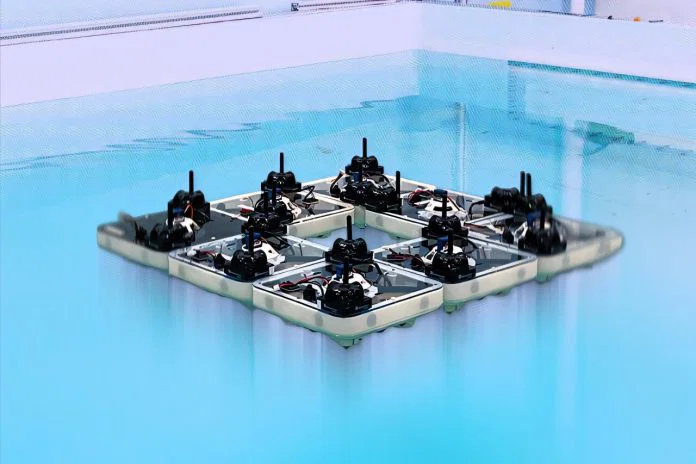
Published in Nature Communications, the study showcases a group of tiny autonomous robot boats capable of self-organizing into larger floating structures with minimal human input. Each boat measures about 8 inches wide — roughly the size of a dinner plate. Despite their small size, every boat is equipped with its own battery, electric motors, sensors, and magnetic connectors, enabling independent movement while collaborating with others.
The team envisions these robotic boats transforming into adaptable floating infrastructure. Potential uses include quickly constructing temporary bridges after natural disasters, creating floating markets along canals, setting up stages for events, or providing work platforms for scientists and engineers.
This idea was inspired by an earlier MIT project involving full-sized autonomous boats used on Amsterdam’s iconic canals, which sparked curiosity about whether smaller robots could team up to build larger structures on demand. A significant challenge was teaching numerous robots to cooperate without relying on a single controlling computer.
To overcome this, the researchers looked to nature for clues. Fire ants, for instance, can survive floods by linking their bodies into floating rafts without a designated leader. Each ant follows simple local rules, resulting in a stable structure. Similarly, the FloatForm robots communicate solely with nearby units, determining their movements based on local information. A central computer simply assigns each robot a destination; the robots handle navigation, collision avoidance, and connections themselves.
This decentralized approach enhances system reliability. If one robot encounters a problem, the others continue functioning smoothly. For connecting, each robot features a clever magnetic locking system tucked inside its body. A small motor extends or retracts magnets to clasp onto neighboring robots. Once linked, the magnets stay locked without using extra power, conserving battery life.
In laboratory tests, eight robot boats successfully gathered from different starting points, formed a larger floating structure, detached, and reshaped into new configurations. They even managed to move together across the water as a single vessel. Computer models suggest that the same system could coordinate larger groups of up to 64 robots.
Beyond urban waterways, the team sees numerous future applications. Swarms of these boats could assist search-and-rescue operations, monitor water quality, inspect offshore equipment, create temporary floating work platforms, or aid scientists studying wildlife in secluded lakes and oceans.
Currently, the researchers are working on making the robots more durable for outdoor environments and rougher waters. They also plan to replace the indoor tracking system with GPS and other navigation technologies.
Although still in early development, FloatForm offers a glimpse into a future where rivers, lakes, and canals become adaptable spaces capable of changing shape as needed. Instead of permanent structures, cities might rely on intelligent robot swarms to generate floating infrastructure whenever the situation calls for it.
 ChatGPT
 Perplexity
 Gemini AI
 Grok AI