

Select Language:
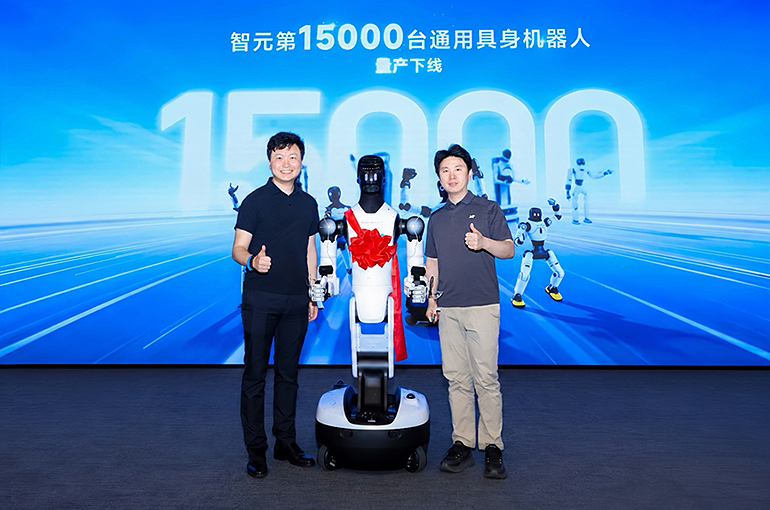
A humanoid robotics startup in China has achieved a significant milestone, delivering its 15,000th robot less than three months after reaching the 10,000th unit sale. This company also completed a six-day livestream demonstration of eight Genie G2 robots performing tablet quality inspections at a factory in Nanchang, Jiangxi province.
The company’s partner and president of its embodied intelligence division noted that shipping the 15,000th robot marks a new phase of mass production and indicates a move towards widespread adoption of humanoid robots in real-world settings. Founded in February 2023, the company sold its 10,000th robot in March and delivered 5,168 units last year, capturing 39% of the global market and ranking first worldwide.
The team spends much of their day overseeing deliveries, ensuring supply chain stability, maintaining quality, and managing engineering updates amid rapid growth. To increase production capacity, a quality engineer was stationed at a supplier’s factory for over three months, which helped boost output fivefold and raise the first-pass yield to over 95%, up from less than 60%.
The company has established a comprehensive supply chain network across the Yangtze River Delta, sourcing more than 70% of its components locally. This effort aims to streamline manufacturing and improve reliability.
The livestream showcased the Genie G2 robots on an active production line, where they operated from 8 a.m. to 7 p.m., matching the factory’s schedule. They sorted over 17,000 tablets during testing, achieving a success rate of 99.99%. The robots started working on a secondary line in December before transitioning to the main line in March.
Despite some initial setbacks—such as a communication failure that caused a brief drop in efficiency—the robots quickly recovered, with issues reported and resolved in real-time. For instance, when a robot experienced a fault, it promptly switched stations and resumed operations within minutes, demonstrating resilience.
During the live test, multiple issues like sensor errors and communication mismatches were identified and addressed. The team views these challenges as essential steps toward broader deployment, believing troubleshooting during live demonstrations accelerates progress.
The livestream was broadcast on domestic and international platforms, with some viewers comparing it to previous warehouse sorting tests, though they noted that working within an active manufacturing environment introduces more variables.
Following deployment, the company and its partner have dealt with approximately 60 issues, from collision-causing sensor errors to command communication problems. Ensuring stable, reliable operation at customer sites remains the next critical focus.
The company’s goal is to develop robots that can operate seamlessly alongside human workers, maintaining high reliability and matching human productivity. Currently, its AI systems still require training and fine-tuning by engineers for new tasks, as they are not yet capable of learning simply by observation.
The vision is to produce robots that can be deployed immediately—similar to buying a car and starting to use it right away—thereby reducing the time between manufacturing and operational readiness. To facilitate this, the company is expanding its partner ecosystem by providing training programs that enable developers to maintain and troubleshoot robots independently and refining its supporting software tools.
Additionally, they introduced Genie Studio Agent, a platform that helps partners develop customized applications and integrate robots more efficiently into client operations, lowering deployment barriers.
Customer orders are shifting from pilot projects to bulk purchases, with more than 1,000 units expected to be delivered by year’s end across industries such as semiconductor manufacturing, automotive parts, logistics, and commercial services.
In March, the robots were deployed on a production line at an automotive battery plant, performing high-precision tasks with an accuracy of ±0.1 millimeters—marking the first time a Chinese automaker’s robot was used in mass production within the auto industry.
The company also announced plans to expand internationally. Revenue from overseas markets, which was less than 10% last year, nearly doubled in the first half of this year, with North America, Europe, Japan, and South Korea identified as key target regions.
Industry analysts project that global demand for humanoid robots could reach approximately 86 million units by 2050, creating a market valued between $1.4 trillion and $1.7 trillion. However, a rapid industry surge similar to the electric vehicle boom before 2030 is unlikely due to immature AI technology, limited training data, and a lack of comprehensive regulations.
 ChatGPT
 Perplexity
 Gemini AI
 Grok AI