
Select Language:
According to recent reports, Google’s highly anticipated Gemini 3.5 Pro large language model is set to launch on July 17th, marking a significant delay from its original announcement at May’s IO Conference. The tech giant initially promised the flagship model would be released in June but had to postpone the release, partly due to internal challenges and the departure of several AI industry leaders to competitors, which dampened team morale.
Interestingly, the mid-July release also coincides with the official launch of DeepSeek V4, creating an exciting showdown between two of the world’s leading AI models. This timing promises a robust comparison of domestic and international AI technologies in action.
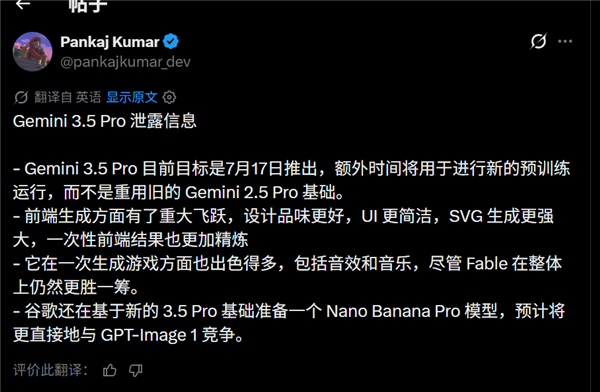
Google explained that the delay was necessary to incorporate a new round of pretraining for Gemini 3.5 Pro. Instead of fine-tuning an older Gemini 2.5 Pro model, the team aimed to develop a completely new foundation, expecting this approach to yield substantial improvements. The upgraded model is said to feature significant advances in frontend generation, with better design aesthetics, a more streamlined user interface, and enhanced SVG creation capabilities, all contributing to more refined and immediate front-end results.
The updates extend beyond visuals; notable progress has been made in gaming development applications. However, industry insiders suggest that Gemini 3.5 Pro still can’t surpass AI competitor Anthropic’s Fable 5, which reportedly boasts between 50 trillion and 100 trillion parameters, marking it as a cost-heavy but extremely powerful model.
This upcoming release won’t be just an incremental upgrade. Google intends to build Gemini 3.5 Pro from the ground up, offering a brand-new core architecture. The company is prioritizing quality training over speed, even if that means additional delays, to ensure a significant leap in performance.
One of Google’s longstanding strengths has been the breadth of knowledge embedded within its models. Even DeepSeek’s officials acknowledge Google’s dominance in this area, and higher data quality is expected to directly translate into enhanced model performance for Gemini 3.5 Pro.
Yet, it’s unlikely this new model will instantly top global rankings. Leading models like Mythos and Fable, with sizes reaching up to 10 trillion parameters, are pushing the boundaries of scale with enormous costs involved. Gemini 3.5 Pro, while powerful, won’t match these colossal models yet, leaving some gaps in the upper echelon of AI development.
Another advantage for Google lies in image generation. Its Nano Banana model, long regarded as a world leader in AI-generated images, was recently surpassed by OpenAI’s GPT-Image 2. Google’s plans include launching a new version, Nano Banana Pro, based on Gemini 3.5 Pro, which is expected to more directly challenge GPT-Image 2’s market dominance.
As the industry watches these developments unfold, the upcoming mid-month release promises to be a notable milestone in AI’s ongoing evolution, blending advancements in language processing with competitive innovations in image generation technology.
 ChatGPT
 Perplexity
 Gemini AI
 Grok AI